What Is the x402 Crypto Payment Standard — and Why Are AI Agents Starting to Need It?
What is x402? Learn how the HTTP payment standard lets AI agents and software pay for APIs, data and digital services programmatically.
KoinLens Research 10 min read
An AI agent can already search the web, call an API, retrieve data and use external tools. But imagine it needs a service that costs $0.02. A person can enter card details, create an account, approve a payment. An autonomous piece of software cannot easily do any of that on its own. So if software can request a service automatically, why can it not pay for that service automatically too? That is the problem x402 is built to address.
The short version
x402 is an open payment standard that adds a machine-readable payment step to ordinary HTTP interactions. A server can answer a request with402 Payment Required, state what payment it needs, and let the client pay and try again.
It matters for AI agents because software can then pay for APIs, data and other digital services without a human completing a checkout.
AI agents can use services. Traditional payments assume humans.
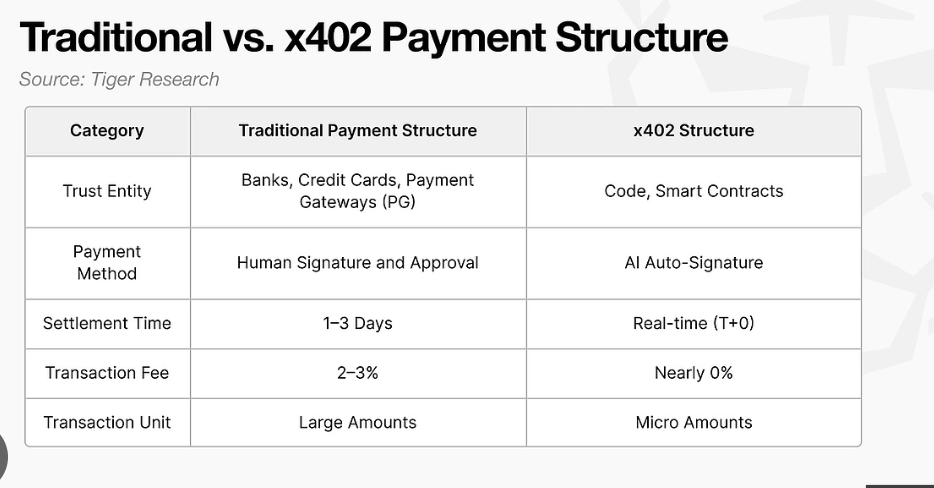
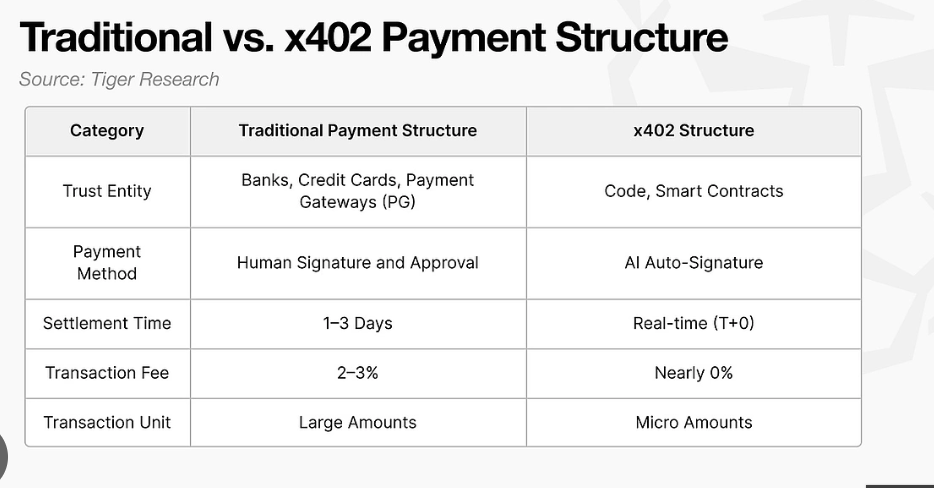
Paying for something on the internet usually assumes a person is present. A human visits a site, makes an account, enters payment details, approves the transaction, and the service unlocks. That works well enough when the customer is a person.
Now picture an AI agent running continuously. Over a day it might need a weather API, market data, blockchain data, search results, compute, a model call, a specialised database - hundreds or thousands of times. Asking a human to approve each one removes most of the point of building an autonomous system in the first place.
The shape of the two flows is the difference:
- Traditional: human -> website -> login -> card or checkout -> service
- Machine-native: agent -> API request -> payment required -> programmatic payment -> service
First, what does "402 Payment Required" mean?
HTTP has carried a status code called 402 Payment Required for decades. It was reserved early on for exactly this purpose and then left largely unused, because there was no agreed way for a client and a server to settle a payment between themselves.
x402 builds a practical flow around that dormant code. Think of asking a restaurant for a meal and being told: the meal costs $5, pay $5 and it is yours. You pay, you get the meal. x402 applies that idea to internet services.
How an x402 payment works
The general shape of the exchange:
- The client asks for a resource. An agent sends
GET /api/data. - The server answers
402 Payment Required. The response carries what is needed - amount, asset, network, and where the payment should go. - The agent prepares payment. Its wallet signs the required authorisation.
- The payment is verified or settled by the payment infrastructure.
- The agent retries, this time carrying the payment.
- The server returns the resource with
200 OK.
The exact mechanics depend on the version, network and payment scheme in use. The steps above describe the concept rather than any single implementation.
Why AI agents are the interesting case
Agents differ from ordinary software in a way that matters here: they decide. They call tools, reach external APIs, run continuously, work through multi-step tasks and change course as information changes.
Say a user asks a travel agent: find me the cheapest flight and hotel for next weekend. The agent may search flight data, query hotels, check the weather, compare prices, pull maps, and call one more API it did not plan for. If several of those carry a small usage fee, the agent needs a way to settle them itself. A protocol like x402 is one answer to that.
Take a research agent that wants a specialised market-data API at $0.01 a request. Instead of create account -> get API key -> pick a subscription -> manage a billing dashboard, the flow becomes: request data -> 402 Payment Required -> price is $0.01 -> agent authorises -> payment verified -> data returned.
The point is not the cent. The point is that the payment becomes part of the software-to-software conversation rather than a separate step arranged in advance by a human.
What makes it different from normal API billing
Traditional billing and an x402-style flow solve the same problem from opposite ends:
- Account setup - usually required up front, versus a flow that can be designed for direct machine interaction.
- Access control - an API key issued ahead of time, versus payment tied to the request itself.
- Pricing model - subscriptions are the norm, versus pay-per-use being practical.
- Checkout - built for a human, versus machine-readable.
- Where billing lives - a separate system, versus integrated into the HTTP interaction.
- Repeat requests - account management, versus programmatic access by design.
None of this means API keys, subscriptions and payment providers disappear. x402 is an additional model for the cases where programmatic, usage-based payment is the useful thing.
Why crypto is involved
A few properties make blockchain-based payment a natural fit, none of which are unique virtues and all of which have limits.
Programmability. Software can sign transactions or payment authorisations itself, without a human-facing form in the loop.
Reach. A blockchain-based payment system can work across borders without every service integrating separately with every local banking system.
Settlement speed. Some supported networks settle quickly.
Small amounts. Usage-based services can charge fractions of a cent, where conventional payment rails are often impractical.
Composability. The payment can sit inside an automated workflow instead of in a billing system alongside it.
Worth being precise: fees, speed and settlement behaviour vary enormously by network and payment mechanism. "Crypto is fast and cheap" is not a property of crypto; it is a property of particular chains at particular moments. Notably, x402 V2 also supports conventional rails - facilitators for ACH, SEPA and card networks fit the same model - so this is not strictly a crypto-only standard.
Why stablecoins come up
x402 can carry payment in digital assets, and stablecoins such as USDC are the obvious candidates because their value is designed to track a fiat currency. If an API charges $0.02, a dollar-denominated stablecoin expresses that price directly. A volatile asset would mean the price of a single API call drifts between the quote and the settlement.
Stablecoins still carry issuer, regulatory, smart-contract, liquidity and infrastructure risk. Stable is not the same as risk-free.
Important: x402 is a payment standard, not a cryptocurrency.
There is no x402 token to buy, and the protocol existing does not create one. Its role is closer to a communication standard - it defines how a client and a server handle a payment-required interaction over HTTP. If you see "x402" quoted as a coin, that is a misunderstanding worth correcting.
What changed in V2
x402 launched in May 2025 with a deliberately narrow idea: embed payment in HTTP using the 402 status code. V2, announced in December 2025, rebuilt the specification around what six months of real use had exposed.
The headline changes: a unified payment interface that identifies networks and assets the same way across chains, and works with legacy rails; multi-chain support by default, including Solana, Base and newer L2s, without custom logic; dynamic routing, so payment destinations can be decided per request; wallet-based identity and reusable sessions, so an agent does not re-pay on every single call; automatic service discovery; and a modular SDK where new chains and schemes are plug-ins rather than edits to the protocol. The reference SDKs remain backward-compatible with V1.
Why it matters
"Pay once, get one response" is a fine demonstration. An agent working through a real task makes many calls. Sessions, discovery and flexible routing are what make that second case buildable.
Is x402 controlled by one company?
It started at Coinbase. It is no longer theirs alone.
On 14 July 2026 the Linux Foundation announced the operational launch of the x402 Foundation, an open-governance body formed to steward the protocol, and confirmed that Coinbase had completed its contribution of x402. Forty organisations had joined as members since the Foundation announced its intent in April. Premier members include Adyen, AWS, American Express, Circle, Cloudflare, Coinbase, Fiserv, Google, Mastercard, MoonPay, Ripple, Shopify, the Solana and Stellar foundations, Stripe and Visa.
The governance model, in other words, is moving from a Coinbase-originated project toward vendor-neutral stewardship. That is a meaningful change in who decides what the standard becomes - though membership lists describe intent, not adoption.
Where it could be used
Potential use cases include:
- AI agents paying for data, APIs, tools and compute as they work.
- Developer APIs charging per request instead of requiring a subscription.
- Autonomous software acquiring the resources it needs, when it needs them.
- Digital marketplaces where many services charge for usage automatically.
Potential is the operative word. Several of these exist today as demonstrations rather than as businesses.
The interesting part is not the payment. It is that software becomes a customer.
For thirty years internet services were designed around one shape of customer: human -> website -> account -> payment -> service. Every part of that chain assumes a person is present to make a decision.
AI agents change the shape. The customer may increasingly be software that discovers a service, reads its price, decides whether it is worth paying for, authorises the payment and consumes the result - all inside one automated workflow. If that becomes common, payment stops being a checkout step bolted to the side and becomes part of the API itself.
The KoinLens view: we score every coin in our directory for trust and risk, so we spend a lot of time on the difference between a claim and a measurement. On x402, we think the question worth watching is not whether x402 specifically becomes the standard. It is whether the internet develops any common way for software to buy from software. If it does, something shaped like x402 ends up in the plumbing underneath agentic applications. That is analysis, not a prediction - and the two should not be confused.
What x402 does not solve
Autonomous payment creates problems that autonomous payment cannot fix.
Agent authorisation. How much should a piece of software be allowed to spend, and who decides?
Malicious services. An agent can be pointed at a fraudulent endpoint as easily as a legitimate one.
Payment errors. Software needs hard limits against accidental or repeated spending.
Network costs. Fees vary by chain and mechanism, and can exceed the value of a small payment.
Asset risk. If a volatile asset is used, the value moves between quote and settlement.
Infrastructure dependency. Facilitators, wallets, networks and providers each add a point of failure.
Regulation. Machine-to-machine payment raises live questions about compliance, consumer protection and who is liable when an agent spends badly.
The hard problem may not be making an agent capable of paying. It may be making autonomous spending safe.
How to tell whether it is actually working
Adoption claims are easy. These are the signals worth tracking instead:
- Transaction activity - are real payments growing, or flat outside launches?
- Sellers - are more APIs and services accepting x402 payments?
- Buyers - are agents and applications actually paying?
- Repeat usage - are services used again, or only in demos?
- Developer adoption - is the standard reaching shipped products?
- Ecosystem diversity - is activity spread across networks, facilitators and applications, or concentrated in a few?
Snapshot - checked 24 September 2026
Last 30 days, as published on x402.org: 75.41M transactions, $24.24M volume, 94.06K buyers, 22K sellers.
These are the protocol's own published figures, not independently audited, and they will change. Treat them as a starting point for your own checking rather than as verification.
The bigger picture
The interesting thing about x402 is not that it puts crypto into an HTTP response. It is that it treats payment as something software can understand.
Today an agent can call an API. Tomorrow it may also need to judge which API is worth paying for, authorise the payment, and carry on without waiting for anyone. Whether x402 becomes the standard for that is genuinely unsettled. The problem it is aimed at is not.
In one line
x402 is an attempt to make internet payments as programmable as internet requests.
KoinLens takeaway: watch the adoption, not the hype. The signal that matters is whether real applications, APIs and agents start making machine-native payments at scale.
Sources
- x402 official site - protocol overview and published activity figures
- Introducing x402 V2 - the V2 specification announcement
- Linux Foundation announces operational launch of the x402 Foundation - governance and membership
- x402 whitepaper
More from KoinLens
KoinLens scores every coin for trust and risk and shows the signals behind the number, and lists airdrops with the reasoning attached: koinlens.com.
Follow us on X and LinkedIn for daily checks.
This article explains a technology. It is not investment advice, and nothing here is a recommendation to buy any asset.
Comments
- M
Member5 hours ago
Great information 🔥